01 / 04
Coordinate
A 36-role architecture routes work through specialized agent responsibilities instead of treating every request as a single undifferentiated prompt.
The public engineering repository documents 36 specialized agent roles with scoped context, planning, approved research, and gated tool use. Read the code and follow the development state rather than taking a benchmark claim on faith.
View public repositoryArchitecture, memory, tools, training pipeline, checkpoint verification, inference runtime, and evaluation system.
Dataset preparation, GPU training, the initial checkpoint, inference verification, and measured evaluation results are next.
The architecture is designed for explicit coordination and controlled access to context and tools.
A 36-role architecture routes work through specialized agent responsibilities instead of treating every request as a single undifferentiated prompt.
Scoped memory retrieval supplies relevant context to the workflow without implying that every agent sees everything.
Planning and reasoning components organize work before execution. The architecture is inspectable in the public repository.
Web research is approval-based. Tool execution is gated, and Python runs in an external sandbox.
The repository includes an SFT / DPO / QLoRA training pipeline, checkpoint verification, a local inference runtime, and an evaluation system. These are infrastructure capabilities, not evidence that a proprietary model is already trained or has passed a measured evaluation.
See development progressGPU training, an initial checkpoint, inference verification, and measured evaluation results are not complete.
These product interfaces are available separately from the training roadmap.

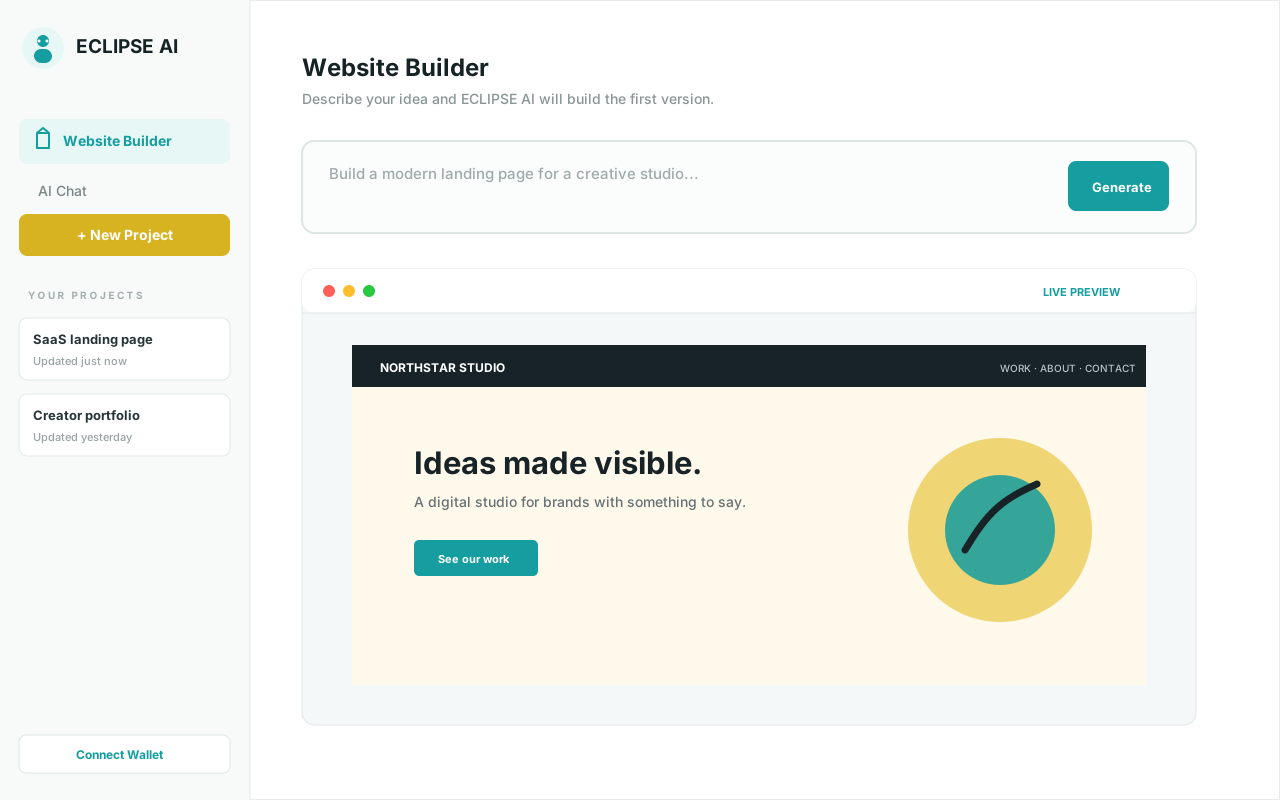
Describe a page, generate it, and review the output in the builder.
Open website builderThe public repository is the most direct account of the system's implementation.